
Timely Filing Limits: A Payer-by-Payer Guide for Billing Teams
- Sizzly Auer

- Aug 13
- 13 min read

Timely filing limits are the payer-set deadlines for submitting a claim after the date of service, and missing them costs your practice real money with almost no path to recovery. For most billing teams, the practical ranges look like this:
Original Medicare: 12 months from the date of service (1 calendar year)
Medicare Advantage: typically 90–180 days, but contract terms govern
State Medicaid: timeframes vary widely by state and exception category, sometimes extending beyond a year
Commercial insurers: commonly 90–180 days, sometimes as short as 60 days per contract
The immediate action: pull every active payer contract and provider manual today, confirm the exact window and clock-start rule for each, and check whether any denied claims are still within the appeals period. The rest of this guide explains how to do that systematically.
Key Takeaways
Timely filing limits are payer-set deadlines that, once missed, convert a billable claim into a permanent write-off with almost no recovery path.
Point | Details |
Know your payer’s exact window | Original Medicare allows 12 months; commercial plans can be as short as 60 days per contract. |
The clock starts at date of service | For secondary claims, it starts at primary adjudication; confirm the rule for each payer category. |
State Medicaid rules vary widely | Illinois allows 180 days standard but 2 years for Medicare-denied crossovers; check every state’s manual. |
Build and verify a payer tracker quarterly | A tracker built on last year’s manual is a liability; payer policies change and so do MAC transmittals. |
Bestwaymedicalbilling supports appeals and policy setup | A practice consultation includes a payer-policy review, tracker setup, and denial assessment for women’s health practices. |
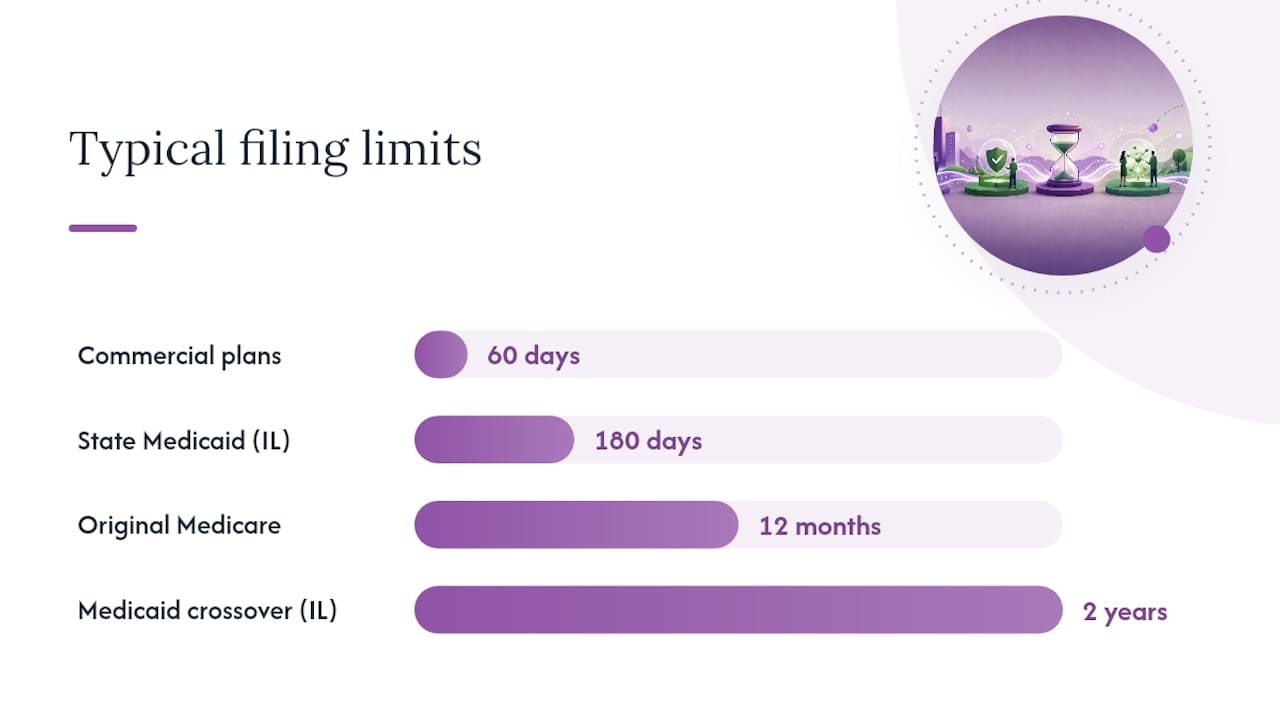
Table of Contents
What timely filing limits actually mean for your revenue cycle
Payer-by-payer breakdown: what are the typical filing deadlines?
Do timely filing limits vary by state, and how do you check?
When can you appeal a late submission, and what documentation wins?
How the 2027 maternity coding changes affect your filing logic now
The mistakes we see most often, and the one fix that matters
Bestwaymedicalbilling handles the filing deadlines your team shouldn’t have to chase
What timely filing limits actually mean for your revenue cycle
In medical billing, a timely filing limit (also called a claims submission deadline or allowed filing period) is the maximum number of days a provider has to submit a claim to a payer before that payer will refuse to process it on timeliness grounds alone. The limit is not a soft suggestion. Once it passes, the payer issues a denial with a specific reason code, and in most cases that denial becomes a permanent write-off.
Three parties set these limits:
CMS and Medicare Administrative Contractors (MACs): for Original Medicare claims
State Medicaid agencies: through provider manuals and state plan amendments
Commercial payers and Medicare Advantage plans: through individual provider contracts and plan documents
The revenue impact is direct. A single missed deadline on a $3,000 obstetric claim is $3,000 gone, not delayed. Multiply that across a practice with high prenatal visit volume and the write-offs accumulate fast. Timely filing limits show up in several places billing teams must monitor:
Provider participation contracts (often buried in exhibits or addenda)
Payer provider manuals and online portals
State Medicaid regulations and provider bulletins
CMS transmittals and MAC-specific guidance
Payer-by-payer breakdown: what are the typical filing deadlines?
The table below reflects standard industry ranges. Always confirm the exact window in the payer contract or provider manual, because contract terms can shorten these windows for commercial and Medicare Advantage plans.
Original Medicare gives providers the most runway. Medicare policy and MAC guidance confirm the standard 12-month window, measured from the date the service is considered incurred. That said, certain service types, including lab and clinical laboratory services, follow specific date-of-service rules published by CMS that can shift the anchor date.
Medicare Advantage plans are where billing teams get caught most often. The plan is administered by a private insurer, which means the contract, not Medicare’s 12-month rule, controls the deadline. A plan might specify 90 days with no exceptions. Read the contract.
Medicaid is the most variable category. Because Medicaid is administered at the state level, each state sets its own window through its provider manual and plan rules. Some states allow 365 days; others cap at 90. Crossover claims and retroactive eligibility situations often carry separate, longer windows.
Commercial insurers tend to have the tightest deadlines. Sixty days is not unusual for some plans, and the contract language rarely leaves room for interpretation.
When does the timely-filing clock actually start?
This is where billing teams lose the most money to avoidable errors. The clock start is not always the date you billed, and it is not the date the patient was seen on your schedule. The most common start points are:
Date of service: the default for most payers and most claim types
Date of discharge: for inpatient hospital claims
Date of delivery: for global obstetrical packages under Medicare (Noridian’s maternity services guidance specifies delivery as the incurred date for global OB procedures)
Date of primary adjudication: for secondary claims and crossovers, the clock typically starts when the primary payer issues its explanation of benefits (EOB), not when the patient was seen
Date of retroactive eligibility determination: when a payer retroactively enrolls a patient, many states allow the filing window to start from the determination date rather than the service date
CMS date-of-service policy is particularly relevant for lab and clinical laboratory claims, where the service date may differ from the collection date. For prenatal lab billing, this distinction matters: the date the specimen was collected versus the date the lab processed it can affect which date anchors the claim.
Billing teams commonly confuse “date of billing” with “date of service.” The date your practice generated the claim in the EHR is irrelevant to the payer’s clock. What matters is the date the service was rendered, or whichever alternative trigger the payer explicitly defines.
Pro Tip: Document the clock-start date in the claim file at the time of submission. Add a field in your practice management system or clearinghouse notes that records the filing window expiration date alongside the claim. When a denial comes in 90 days later, you will know immediately whether an appeal is viable.
Do timely filing limits vary by state, and how do you check?
Yes, and the variation is significant enough to cause real revenue leakage when a practice assumes a uniform national rule applies everywhere. State Medicaid programs set their own windows through provider manuals, state plan amendments, and periodic bulletins. The federal government aggregates state plan information at medicaid.gov, but the operative rules live in each state’s own documentation.
How to verify your state’s rules:
Go to the state Medicaid agency’s provider portal and download the current provider manual
Search for “timely filing” or “claims submission” in the manual’s index
Check for recent provider bulletins that may have updated the window since the manual was last published
Confirm whether your state has separate windows for institutional versus non-institutional providers
Illinois example: Illinois Medicaid typically requires non-institutional providers to submit claims within approximately six months of the date of service. That sounds strict, but the state documents several exceptions that extend the window significantly:
Exception Category | Extended Deadline |
Medicare-denied crossover claims | 2 years from date of service |
Provider enrollment delays | Extended window from enrollment date |
Third-party liability (TPL) situations | Extended from date of TPL determination |
Retroactive eligibility | Extended from eligibility determination date |
Illinois is a useful benchmark because it illustrates how a state can pair a tight standard window with generous documented exceptions. The key word is documented: the exception only applies if the billing team can produce the evidence that triggers it.
What happens when you miss the timely filing deadline?
The most common result is an automatic denial with a reason code indicating untimely submission, typically CO-29 (“The time limit for filing has expired”) on the remittance advice. That denial, in most cases, cannot be billed to the patient. It becomes a write-off.
The operational consequences extend beyond the single claim:
AR aging: untimely denials inflate days in accounts receivable and distort your AR aging reports, making it harder to spot other problems
Patient balance risk: if the write-off is mishandled, some practices inadvertently bill patients for amounts that should have been absorbed, creating compliance exposure
Audit exposure: a pattern of untimely filing denials can attract payer audits and credentialing scrutiny
Staff time: working denials that are already past the appeals window wastes biller hours that could go toward recoverable claims
When you discover a late claim, work through these steps before writing it off:
Verify the denial reason code. Confirm it is CO-29 or the payer-equivalent untimely code, not a different denial type that happens to look similar.
Check the contract and provider manual. Confirm the exact filing window and clock-start rule for that payer.
Identify whether an exception applies. Was there a retroactive eligibility change? A primary payer denial? A provider enrollment issue covered under 42 CFR 424.44?
Assemble your evidence. Gather the original submission confirmation, clearinghouse timestamp, EOB from any primary payer, and any documentation of the exception trigger.
Submit the appeal or override request. Follow the payer’s specific appeal process; label the submission clearly as a timely-filing exception request.
Track the outcome. Log the appeal date, deadline, and result in your denial tracking system.
When can you appeal a late submission, and what documentation wins?
Appeals for untimely filing succeed when the billing team can demonstrate that the late submission was caused by a documented, payer-recognized exception, not just an internal oversight. Vague claims that a claim “was mailed earlier” rarely succeed. What works is primary-adjudication evidence and official documentation.
Evidence types that support a successful exception:
EOB or EOMB from the primary payer showing the date of adjudication (critical for secondary and crossover claims)
Clearinghouse submission timestamps proving the claim was submitted before the deadline
Provider enrollment or revalidation documentation showing that a delay in enrollment under 42 CFR 424.44 prevented timely submission
State or payer system outage notices from the relevant period
Retroactive eligibility determination letters from the payer or Medicaid agency
Proof of coordination of benefits (COB) processing delays from the primary insurer
Step-by-step appeal process:
Obtain the payer’s specific appeal form or override request form from the provider portal.
Attach all supporting documentation in the order the payer specifies (many payers reject appeals for missing attachments, not missing evidence).
Have the billing manager or practice owner sign the appeal letter; some payers require a provider signature.
Label the submission clearly: “Timely Filing Exception Request” in the subject line and on the cover sheet.
Submit via the payer’s required channel (portal, fax, or mail) and retain proof of submission.
Log the appeal deadline (typically 30–60 days from the denial date) and calendar a follow-up.
For complex cases, escalate to the payer’s provider relations line before the appeal deadline. A phone call that documents the exception category on record can sometimes accelerate the override decision.
How to track and manage filing deadlines before they expire
The most effective way to eliminate untimely filing denials is to make the deadline visible before the claim is submitted, not after it is denied. That requires a payer tracker and a consistent workflow.
Payer tracker columns to build:
Payer name and plan type
Filing window (days)
Clock-start rule (date of service, date of discharge, date of adjudication)
Contract section or manual page reference
Claim submission date
Filing window expiration date (calculated field)
EOB received date (for secondary claims)
Appeal deadline (if applicable)
Daily, weekly, and monthly workflow:
Daily: Review clearinghouse error reports. Any rejected claim needs a corrected resubmission date logged immediately against the original date of service.
Weekly: Run an AR aging report filtered by claims approaching 60 days without adjudication. Flag any claim within 30 days of its filing window expiration.
Monthly: Conduct a pre-write-off audit of all claims in the 90-day-plus bucket. Separate untimely denials from other denial types and assess appeal viability before writing off.
Quarterly: Verify the payer tracker against current provider manuals and MAC bulletins. Payers update their policies, and a tracker built on last year’s manual is a liability.
Pro Tip: Set automated alerts in your clearinghouse or RCM platform to flag claims that have not received an adjudication response within 45 days of submission. For midwife and birth center claims with longer prenatal visit billing cycles, this early warning prevents the 90-day deadline from arriving unnoticed.
For midwife claim submissions, automating the crossover and secondary submission trigger is particularly valuable. When the primary payer adjudicates, the secondary claim should enter the queue the same day, not when someone remembers to check the EOB.
Special situations that change the filing clock
Several claim types carry specific timing rules that differ from standard claim windows, and misunderstanding these can lead to avoidable write-offs.

Coordination of benefits (COB): When a patient has two active payers, the secondary claim’s filing window typically starts on the date the primary payer adjudicates, not the date of service. Confirm this with the secondary payer’s contract before assuming the standard window applies.
Retroactive eligibility: If a Medicaid patient’s eligibility is determined retroactively, most state programs allow the filing window to start from the eligibility determination date. Document the determination letter and attach it to the claim.
Corrected claims versus replacement claims: A corrected claim (submitted with frequency code 7) replaces a previously processed claim with an error. The timely filing clock for the corrected claim is typically measured from the original date of service, not the correction date. Some payers, however, allow a separate window from the date of the original remittance. Check the payer manual.
Void and rebill: Voiding a claim (frequency code 8) and resubmitting it as a new claim restarts the submission process but does not restart the timely filing clock. The original date of service still governs.
Crossover claims (Medicare to Medicaid): These follow a specific workflow. Medicare adjudicates first and ideally auto-crosses to Medicaid. When auto-crossing fails, the billing team must submit manually with the Medicare EOMB attached. The filing window for the Medicaid portion typically starts at Medicare’s adjudication date, and states like Illinois extend this to 2 years for documented Medicare-denied crossovers.
Global obstetrical packages: Under Medicare, Noridian’s guidance treats the delivery date as the incurred date for global OB procedures. For practices billing global maternity packages, the entire prenatal visit billing sequence anchors to that delivery date for Medicare purposes.
How the 2027 maternity coding changes affect your filing logic now
The AMA’s CPT 2027 maternity care coding changes are the most significant shift in maternity billing logic in years. The new codes move reporting toward encounter-based daily reporting, introducing two levels (Straightforward and Complex) for initial and subsequent care days. CMS review and RVU proposals are scheduled through 2026 for implementation on January 1, 2027.
For billing teams, the practical consequence is this: the single “delivery date” anchor that currently governs global OB package claims will no longer work as the sole filing trigger. Each prenatal encounter will need its own filing window tracked from its own date of service. Practices that do not update their billing system logic before January 1, 2027 will generate systematic denials on routine prenatal visit billing.
Operational steps to take now:
Audit your current billing software configuration to identify where the “delivery date” is hard-coded as the claim anchor for maternity services
Work with your EHR or practice management vendor to add encounter-level date tracking for prenatal visits
Retrain billing staff on which dates trigger filing windows under the new encounter-based model
Review any maternity billing changes guidance from your MAC and update your payer tracker accordingly
Run a retrospective audit of prenatal visit claims from the past 12 months to identify any existing timely filing gaps before the new codes take effect
The shift to encounter-based maternity reporting is not just a coding update. It changes the fundamental architecture of how filing deadlines are calculated for prenatal care. A practice that tracks one deadline per pregnancy will need to track one deadline per encounter. That is a workflow change, not just a code swap, and it needs to be operational before the first claim goes out under the new system in 2027.
For lactation services billing, the same principle applies: each service date creates its own filing window, and administrative delays in coverage verification can push a claim dangerously close to the deadline before it is even submitted.
The mistakes we see most often, and the one fix that matters
Three avoidable errors account for the majority of timely filing write-offs in women’s health practices:
Relying on a rule of thumb instead of the contract. “We always have a year” is not a policy. It is an assumption that will cost you money the first time a commercial payer’s contract says 90 days.
Ignoring state-level Medicaid variation. Practices that serve patients across state lines, or that bill Medicaid in a state with a non-standard window, routinely miss deadlines because they applied another state’s rule. The operationally safe approach is a verified payer-policy matrix, confirmed quarterly against current provider manuals and MAC bulletins.
Misidentifying the clock start. Billing from the date the claim was generated rather than the date of service is the single most common internal error. For secondary claims, billing from the date of service rather than the date of primary adjudication is equally costly.
The one fix that addresses all three: build a verified payer-policy tracker and review it every quarter. Not annually. Quarterly. Payers update their manuals, states amend their Medicaid rules, and MAC transmittals change the interpretation of existing policies. A tracker that was accurate in January may be wrong by April. The practices that eliminate timely filing write-offs are the ones that treat the tracker as a living document, not a one-time project.
Bestwaymedicalbilling handles the filing deadlines your team shouldn’t have to chase
Missing a timely filing deadline is a permanent write-off. For women’s health practices managing prenatal visit billing, maternity global packages, lactation claims, and midwife submissions simultaneously, the number of deadlines to track across payers and states adds up fast.

Bestwaymedicalbilling works specifically with midwives, birth centers, doulas, and lactation consultants to build the payer-policy infrastructure that prevents these write-offs before they happen. The engagement starts with a practice consultation that includes a payer-policy review, a verified filing-window tracker for your active payers, and an assessment of any current denials that may still be within the appeals window. From there, the team handles ongoing medical billing and denial appeals so your clinical staff stays focused on patient care. With the 2027 maternity coding changes requiring a full rebuild of how filing anchors are tracked for prenatal encounters, now is the right time to have that infrastructure reviewed by a team that already knows what is coming. Book a consultation to get your payer tracker built and your current denials assessed.
Sources
Every payer category has a primary source that governs the actual rule. These are the pages to bookmark and check when a deadline is in dispute:
This article is general information, not a substitute for advice from a qualified financial advisor. Consult a qualified financial professional about your own circumstances before acting on anything here.
Recommended



Comments