
ICD-10 Pregnancy Codes: A Quick Reference for U.S. Coders
- Sizzly Auer

- Aug 13
- 13 min read

The code range you need for nearly every pregnancy encounter is Chapter 15 (O00–O9A), backed by a small set of Z-codes that carry just as much weight on the claim: Z3A (weeks of gestation), Z34 (supervision of normal pregnancy), Z39 and Z39.2 (postpartum follow-up), Z33.1 (pregnant state, incidental), and Z37 (outcome of delivery). Get these right and most maternity claims move through clean. Get them wrong, and you’re looking at a payer request for more information or an outright denial.
Here’s the everyday cheat sheet coders actually reach for:
O80 — full-term uncomplicated delivery, used alone as the principal diagnosis
O60.x — preterm labor, with a final character for trimester (O60.02 = preterm labor without delivery, second trimester)
O10–O16 — hypertensive disorders complicating pregnancy, childbirth, and the puerperium
Z3A — weeks of gestation, added to the maternal record whenever gestational age is known
Z34 — supervision of a normal, uncomplicated pregnancy
Z39.2 — the billable code for a routine postpartum follow-up visit
Z33.1 — pregnancy incidental to the reason for the encounter
Z32.0 — encounter for a pregnancy test, result confirmed
Chapter 15 codes take sequencing priority on maternal records. When a non-obstetric condition, like asthma or a urinary tract infection, coexists but doesn’t complicate the pregnancy, you add it as a secondary code. When it does complicate the pregnancy (diabetes, hypertension, thyroid disease), the obstetric coding guidelines direct you to the O-code first, then the underlying condition code as an additional entry.
Key Takeaways
Accurate obstetric coding depends on assigning Chapter 15 (O00–O9A) as the principal diagnosis on maternal records, pairing it with the correct trimester character, and adding Z3A whenever gestational age is documented.
Point | Details |
Chapter 15 leads | O00–O9A codes take sequencing priority on any maternal record over unrelated conditions. |
Confirm trimester every visit | Use LMP or EDD to assign the correct final character; avoid defaulting to unspecified. |
Add Z3A for week-level detail | Include weeks of gestation whenever known to reduce payer requests for more information. |
Tag every fetus in multiple gestation | Assign O30 plus the seventh-character fetus identifier for each complication. |
Use Z39.2 for routine postpartum care | Reserve O85–O92 codes for actual puerperium complications, not routine follow-up. |
Get help closing coding gaps | Bestwaymedicalbilling offers coding reviews and denial appeals built specifically for maternity and women’s health claims. |
Table of Contents
What Are the Major Blocks in ICD-10-CM Chapter 15?
Chapter 15 (O00–O9A) covers pregnancy, childbirth, and the puerperium, and it’s built as a series of blocks organized roughly by clinical timeline rather than by body system. Codes in this chapter are for the maternal record only. The ICD-10-CM tabular structure for O00–O9A confirms these codes never belong on a newborn’s chart, even when the newborn’s outcome is directly tied to a maternal complication.
Here’s how the blocks break down in plain terms:
O00–O08 — pregnancy with abortive outcome (ectopic, molar, spontaneous or induced abortion, and complications following those events)
O09 — supervision of high-risk pregnancy (advanced maternal age, history of infertility, poor obstetric history)
O10–O16 — edema, proteinuria, and hypertensive disorders in pregnancy, childbirth, and the puerperium
O20–O29 — other maternal disorders predominantly related to pregnancy (hemorrhage, hyperemesis, venous complications)
O30–O48 — maternal care related to the fetus, amniotic cavity, and possible delivery problems (multiple gestation, malpresentation, placental issues)
O60–O77 — complications of labor and delivery (preterm labor, obstructed labor, umbilical cord complications)
O80–O82 — encounter for delivery (the “clean” delivery codes)
O85–O92 — complications predominantly related to the puerperium (postpartum hemorrhage, infection, mastitis)
O94–O9A — other obstetric conditions not elsewhere classified, sequelae, and conditions classifiable elsewhere but complicating pregnancy
A patient at 32 weeks with preeclampsia lands in O10–O16. A patient carrying twins with one fetus in breech presentation pulls a code from O30–O48, plus a delivery complication code from O60–O77 if labor doesn’t progress normally.
Chapter 15 codes take sequencing priority on any maternal record. Even when a patient’s chief complaint that day is a sinus infection, if she’s actively pregnant and the encounter touches pregnancy management at all, the O-code generally leads and the sinus infection follows as a secondary code, per the official Chapter 15 guidance.
How Do Trimester and Weeks-of-Gestation Codes Work?
Most obstetric codes end in a character that tells the payer which trimester the encounter falls in, and getting that character wrong is one of the fastest ways to trigger a claim hold. ICD-10-CM defines the first trimester as less than 14 weeks 0 days, the second as 14 weeks 0 days through less than 28 weeks 0 days, and the third as 28 weeks 0 days and beyond, counted from the first day of the last menstrual period, according to the ICD-10 guidelines for O00–O9A.
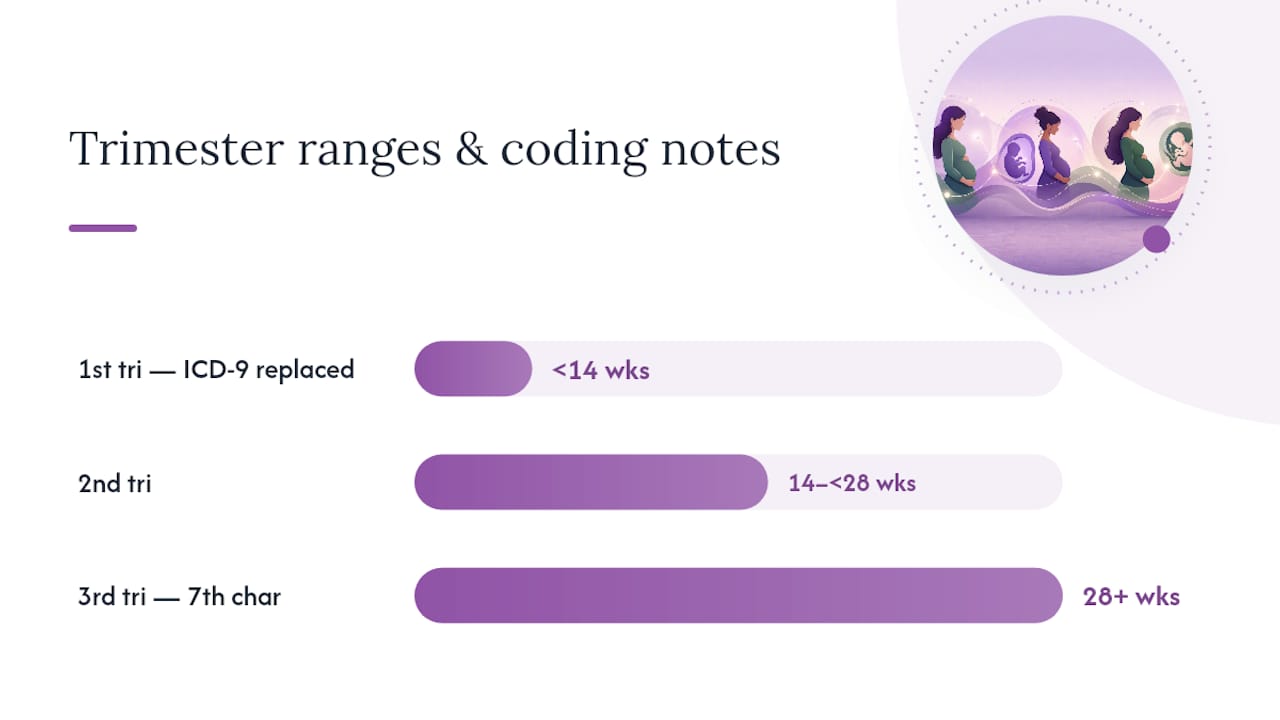
This final character replaced the old ICD-9 episode-of-care system entirely. There’s no more “delivered,” “antepartum,” or “postpartum” modifier tacked onto a condition code. Instead, the trimester character does that job, so O60.02 means preterm labor without delivery, second trimester, in a single code rather than a code plus a separate episode marker.
Not every code uses a trimester character, though. Conditions that by definition occur in only one period, like “in childbirth” or “in the puerperium,” skip the trimester final character because the code title already pins down the timing. And when documentation doesn’t specify trimester, coders default to the unspecified trimester option rather than guessing, though that unspecified choice should be the exception, not the habit.
Z3A codes fill the gap trimester alone can’t close: exact week of gestation. Payers increasingly want week-level detail, not just a trimester bucket, and Z3A entries let you supply it precisely, from Z3A.01 (less than 8 weeks) up through Z3A.49 (49 weeks or greater) for post-term pregnancies. Add Z3A on the maternal record whenever the week is documented and known.
Trimester final character narrows the window to roughly a 14-week range
Z3A narrows it to a single week
Payers reviewing high-risk or multiple-gestation claims often want both
Pro Tip: Push your clinical staff to document LMP, EDD, or an ultrasound-based gestational-age estimate on every prenatal note. That single habit lets coders calculate the correct trimester and Z3A code without chasing down the chart later, which cuts your average claim turnaround time.
Multiple gestation adds one more layer: a seventh character identifying which fetus a complication applies to. That’s involved enough to deserve its own walkthrough, which comes up in the coding guidelines section below.
Which Pregnancy Codes Do Coders Use Most Often?
A handful of codes account for the bulk of maternity claims in any given practice, and knowing their shape (not just their number) saves time on every chart.
Code | Description | Notes |
O80 | Encounter for full-term uncomplicated delivery | Always the sole principal diagnosis; never pair it with another Chapter 15 code |
O60.x | Preterm labor without delivery | Final character (0, 2, 3) indicates trimester |
O10–O16 | Pre-existing and gestational hypertension, preeclampsia | Choose subcategory by hypertension type and severity |
O24.x | Diabetes mellitus in pregnancy | Followed by the underlying diabetes code (E08–E13) as an additional code |
O30.x | Multiple gestation | Requires a seventh character identifying the specific fetus when complications apply |
Z3A.xx | Weeks of gestation | Added whenever gestational age is documented |
Z34.xx | Supervision of normal pregnancy | Used for routine prenatal visits with no complications |
Z33.1 | Pregnant state, incidental | Used when pregnancy has no bearing on the visit’s reason |
Z39.2 | Encounter for routine postpartum follow-up | Billable, applies to patients aged 12 to 55 |
Z37.0 | Single live birth | Added to the mother’s record only, never the newborn’s chart |
The journal of AHIMA’s obstetric coding guidance is explicit that O80 stands alone. If the delivery involved any complication at all, even a minor one, O80 is the wrong code entirely and a more specific O60–O77 code takes over.
Two scenarios show how these codes actually stack up on a real claim:
Routine 28-week prenatal visit, no complications. Assign Z34.82 (supervision of other normal pregnancy, third trimester) plus Z3A.28 for the exact week. No O-code needed since nothing is abnormal.
Delivery at 37 weeks complicated by gestational hypertension. Assign the appropriate O13–O14 hypertension code as principal, with the trimester character reflecting third trimester, plus a delivery outcome code from O80–O82 depending on how the birth resolved, and Z37.0 as an additional code to capture the live birth outcome.
Multiple gestation claims need one more piece: assign the O30 code for the pregnancy itself, then a second code from the relevant subcategory carrying the seventh character (1 through 9) that identifies which fetus the complication involves. Skipping that second code is a frequent finding in payer audits.
What Are the Core Sequencing Rules for Obstetric Coding?
Sequencing is where most billing delays start, and the rule is simpler than it looks once you internalize it: Chapter 15 codes lead on any maternal record, and everything else follows based on whether it complicates the pregnancy.
The logic breaks into three tiers:
The pregnancy itself is the reason for the visit, and it’s uncomplicated. Use the appropriate Z-code (Z34, Z33.1) or O-code (O80) alone.
A condition exists that affects or is affected by the pregnancy. Assign the Chapter 15 code first, then the underlying condition as a secondary code. Gestational diabetes is the textbook case: O24.4 (gestational diabetes) leads, and if an underlying diabetes type needs separate documentation, the guideline directs adding the E08–E13 code as an additional entry.
A condition exists but is unrelated to the pregnancy. Code both, with the reason for the encounter driving which comes first.
A short checklist keeps this from becoming a guessing game on every chart:
Confirm trimester from documented LMP or EDD before assigning the final character
Check whether the condition is pregnancy-related or incidental before choosing between an O-code and Z33.1
For multiple gestation, verify both the O30 code and the seventh-character fetus identifier are present
For chronic conditions like diabetes or thyroid disease, sequence the pregnancy-specific code first and the chronic disease code second
Reconfirm trimester and week of gestation match between the visit note and the code selected before submitting
Pro Tip: When a chart shows a maternal condition that isn’t explicitly labeled as pregnancy-related or incidental, don’t guess. Query the provider. A five-minute clarification saves a thirty-day appeal.
When Do You Use Z34, Z36, and Z32.0 Instead of an O-Code?
Prenatal visits generate a specific family of codes that trips up newer coders because three codes cover very similar-sounding territory: Z34 for supervision, Z36 for screening, and Z32.0 for pregnancy confirmation.
Z32.0 applies at the very first encounter, when the visit’s purpose is confirming a pregnancy, whether by test result or clinical exam and the result comes back positive. This is usually a one-time code early in the pregnancy timeline.
Z34 takes over for ongoing, routine supervision once pregnancy is established and no complications exist. The AAPC coding page for Z34 confirms this category covers supervision of a normal pregnancy through all three trimesters, with subcategories distinguishing first, second, and third trimester supervision.
Z36 covers encounters specifically for antenatal screening, distinct from routine supervision, such as a visit built around a genetic screening panel or an anomaly scan rather than a general prenatal check.
The moment a complication surfaces, whether it’s elevated blood pressure, abnormal glucose, or a fetal growth concern, the coding shifts from a Z-code to the appropriate O-code. A pregnancy that starts as routine supervision under Z34 and later develops gestational hypertension moves to O13 or O14 for that and subsequent visits, with Z34 no longer applying once the complication is active.
A typical prenatal coding flow looks like this:
Positive home test, patient comes in to confirm: Z32.0
Weeks 8 through 36, no issues: Z34.8x plus Z3A.xx for the specific week at each visit
Week 34 visit reveals preeclampsia: shift to O14.x, trimester character for third trimester, plus Z3A.34
How Do You Code Postpartum Visits and Complications?
Postpartum coding hinges on one distinction: is this a routine follow-up, or is the patient being seen for a complication?
Z39.2 is the code for a routine postpartum check, the standard six-week visit or any uncomplicated follow-up in that window. It’s billable and applies to maternity patients aged 12 through 55, and it sits outside Chapter 15 entirely as a Z-code, which surprises coders used to thinking every postpartum entry lives in the O-range.
When the visit is for an actual complication, the O85–O92 block takes over instead:
O85 — puerperal sepsis
O86 — other puerperal infections (wound infection, other postpartum infections)
O87 — venous complications in the puerperium
O90 — complications of the puerperium, not elsewhere classified (postpartum hemorrhage sequelae, disruption of a cesarean wound)
O92 — disorders of lactation (mastitis is elsewhere, but conditions like insufficient lactation and cracked nipple fall here)
If a patient comes in at day 10 postpartum with a fever and wound drainage, that’s O86, not Z39.2, and it becomes the principal diagnosis for that visit. Document the timing carefully. A postpartum complication code generally applies within a defined window after delivery, so the note needs a delivery date to justify the code choice on review.
Lactation and breastfeeding support visits deserve a second look too, since these often get billed as a follow-up but actually reflect a specific condition under O92. If your practice supports lactation consultants, coordinating on how these visits are documented and coded prevents a mismatch between the clinical note and the claim.
What Coding Mistakes Trigger Pregnancy Claim Denials?
Four mistakes account for most of the pregnancy-claim denials we see across women’s health practices, and every one of them is preventable at the documentation stage.
Missing trimester documentation. If the note doesn’t state or allow calculation of gestational age, coders default to an unspecified trimester code, and payers increasingly flag unspecified trimester codes for additional review rather than paying on the first pass.
Skipping Z3A when week specificity is available. AAPC’s guidance on Z3A notes that reviewers commonly expect a week-of-gestation entry when adjudicating pregnancy-related claims, and omitting it when the chart clearly supports it invites a manual review that slows payment.
Defaulting to unspecified codes out of habit. An unspecified hypertension or diabetes code might get through once, but a pattern of unspecified use across a practice’s claims is exactly what payer audit algorithms are built to catch.
Sequencing errors with comorbidities. Putting a chronic condition code ahead of the pregnancy-specific code, or forgetting the additional diabetes code after O24, both create mismatches between the claim and the medical necessity documentation behind it.
A short capture checklist at each encounter closes most of these gaps before the coder ever opens the chart:
Gestational age (LMP, EDD, or ultrasound estimate) noted at every visit
Explicit statement of whether the pregnancy is the reason for the visit or incidental to it
Fetus-specific detail on any multiple-gestation chart (which fetus, which complication)
Delivery date clearly logged for any postpartum-window complication coding
Pro Tip: Reconcile the prenatal record against the delivery record before the claim goes out. We routinely see mismatches where the prenatal chart lists a due date that doesn’t match the delivery note’s gestational-age calculation, and that discrepancy alone is enough for a payer to pause the claim pending clarification.
Why Precise Obstetric Coding Protects Both Patients and Practices
Coding accuracy in obstetrics isn’t a paperwork exercise. It’s the record that determines whether a preterm labor visit gets reimbursed at the right acuity, whether a high-risk pregnancy’s ongoing supervision gets recognized as medically necessary, and whether an audit three years from now finds a clean trail or a gap. Women’s health practices operate on thinner margins than most specialties already, and every unspecified code or missing Z3A entry chips away at revenue that should have been collected the first time.
We’ve spent years working specifically with midwives, birth centers, and lactation consultants, and the pattern repeats across nearly every practice we onboard: the clinical care is excellent, but the coding hasn’t kept pace with how granular payers have become about trimester and gestational week detail. Fixing that gap tends to be the fastest revenue improvement a maternal health practice can make, faster than renegotiating a single payer contract.
Get Obstetric Coding Support Built for Women’s Health Practices
Bestwaymedicalbilling is the alternative to generalist billing firms for practices that live and die by maternity claims: we specialize exclusively in women’s health, so trimester documentation, Z3A specificity, and multiple-gestation sequencing aren’t edge cases we occasionally handle. They’re the daily work.

Our team reviews charts for the exact gaps covered above, missing gestational-age detail, unspecified trimester defaults, and sequencing errors on comorbid conditions, before claims go out the door, and we handle denial appeals when a payer pushes back on a maternity claim that should have been paid the first time. If your practice is bracing for the maternity billing changes on the horizon for 2026 and 2027, our medical coding review services are built to catch these issues at the chart level, and our practice consultation services can help your EMR capture LMP and EDD data cleanly from the first prenatal visit onward.
Ready to see where your current coding stands? Check our pricing and service options to find the right level of support for your practice.
Where Should Coders Look for Official Obstetric Coding Rules?
Four resources cover nearly everything a coder needs for Chapter 15 accuracy, and each serves a different purpose.
Source | Best for |
Full tabular structure, block descriptions, and code lookups | |
Sequencing rules, seventh-character logic, and O80 principal-diagnosis guidance | |
Trimester definitions and incidental-pregnancy (Z33.1) rules | |
Weeks-of-gestation codes and payer-specificity requirements |
Use ICD10Data or AAPC’s Codify tool for day-to-day code lookups, and keep the AHIMA guidance handy for sequencing questions that come up during audits or when training new coding staff.
Frequently Asked Questions
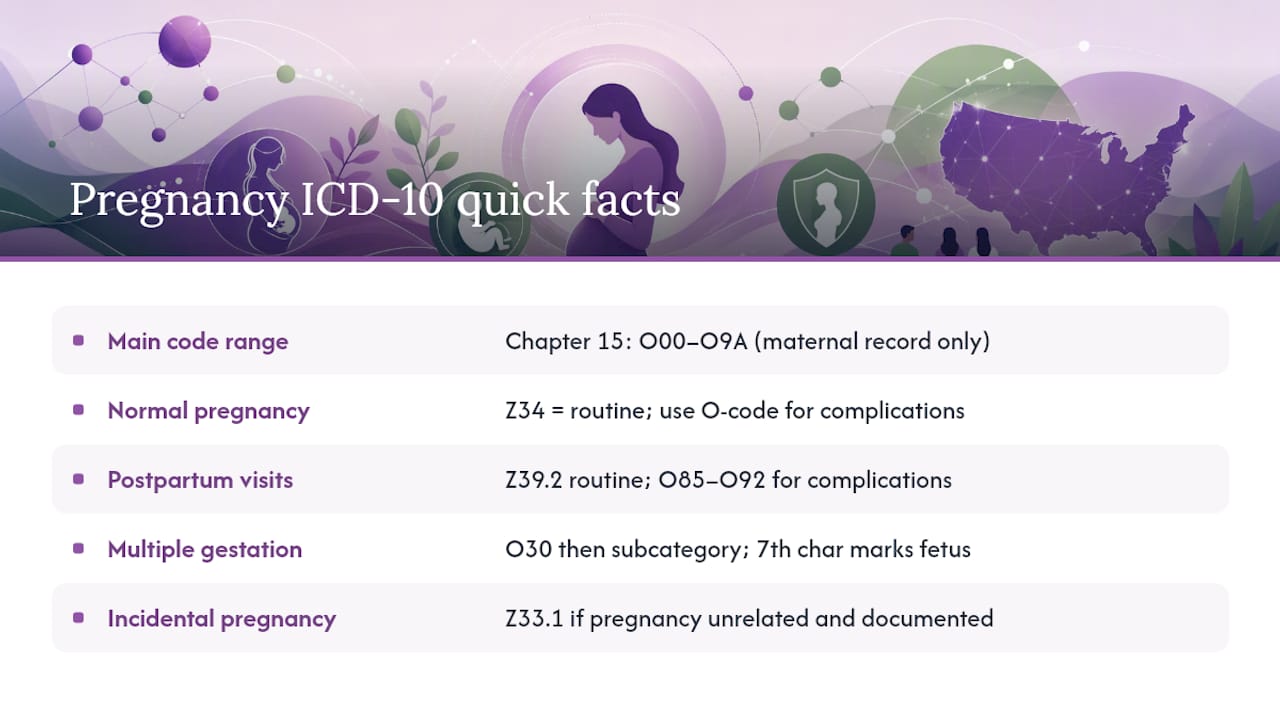
What is the main ICD-10 code range for pregnancy? Chapter 15, spanning O00 through O9A, is the primary range for pregnancy, childbirth, and puerperium diagnoses. These codes apply to the maternal record only.
When do you use Z34 instead of an O-code for pregnancy? Use Z34 for supervision of a normal, uncomplicated pregnancy. Once a complication develops (hypertension, diabetes, abnormal fetal growth), the appropriate O-code from Chapter 15 replaces Z34 for that and subsequent visits.
What’s the difference between Z39.2 and O85–O92 for postpartum visits? Z39.2 covers a routine postpartum follow-up with no complications. O85–O92 codes apply when the visit is for an actual puerperium complication like infection or hemorrhage.
Do all obstetric codes require a trimester indicator? Most do, through a final character on the code. Conditions defined as occurring only during childbirth or only in the puerperium skip the trimester character since the code title already specifies timing.
How do you code multiple gestation pregnancies? Assign the O30 multiple-gestation code, then add a second code from the relevant subcategory with a seventh character (1 through 9) identifying the specific fetus affected by any complication.
What code applies when pregnancy is incidental to the visit? Use Z33.1 when the pregnancy has no bearing on the reason for the encounter, provided the provider documents that the pregnancy is incidental.
This article is general information, not a substitute for advice from a qualified doctor. Consult a qualified healthcare professional about your own circumstances before acting on anything here.
Sources
Recommended



Comments