
Yes, Medicaid Can Reimburse Doulas. Here's How to Get Paid


Most states now reimburse doulas through Medicaid, but the path to actual payment depends entirely on where you practice. As of March 2026, 26 states and Washington, DC now cover doula services in their Medicaid programs, tracked in detail by NASHP and the National Health Law Program’s Doula Medicaid Project.
If you’re wondering whether doula Medicaid reimbursement applies to you, here’s the fast version:
Check your state. Look up your state on the NASHP or NHeLP tracker to confirm coverage and benefit design.
Get your NPI. You need a Type 1 National Provider Identifier before you can enroll anywhere.
Enroll before you bill. Most states require fee-for-service enrollment even if you’ll eventually work with managed care plans.
Three steps, one honest caveat: rates, codes, and enrollment portals differ so much state to state that “Medicaid pays doulas” is true and misleading at the same time. A partner like Best Way Medical Billing can shortcut the credentialing maze if you’d rather not learn six different state manuals from scratch.
Key Takeaways
Doula Medicaid reimbursement works when doulas match their state’s specific enrollment path, coding rules, and documentation requirements before submitting a single claim.
Point | Details |
Coverage is widespread but uneven | 26 states and DC reimburse doulas, but rates, codes, and postpartum windows vary sharply by state. |
Enrollment comes before billing | Get your Type 1 NPI and complete FFS enrollment before pursuing MCO contracts. |
Codes and units are specific | T1032, T1033, and 15-minute unit billing appear across most state manuals, alongside diagnosis code Z32.2. |
Denials are mostly preventable | Wrong codes, incomplete enrollment, and missing documentation cause most claim rejections. |
Outsourcing pays off at scale | A billing partner familiar with maternity coding can cut enrollment friction and speed up payment. |
Table of Contents
Doula Medicaid Reimbursement: Where States Stand Right Now
Doula Medicaid reimbursement isn’t a single national program. It’s 26 separate state decisions, each built on its own legal mechanism and its own rulebook. States authorize the benefit two ways: a State Plan Amendment (SPA), which makes the benefit statewide and permanent, or a Section 1115 waiver, which is often narrower or time-limited. CHCS’s brief on covering doula services walks through how that authorization choice cascades into everything else, including whether you bill fee-for-service or through managed care.
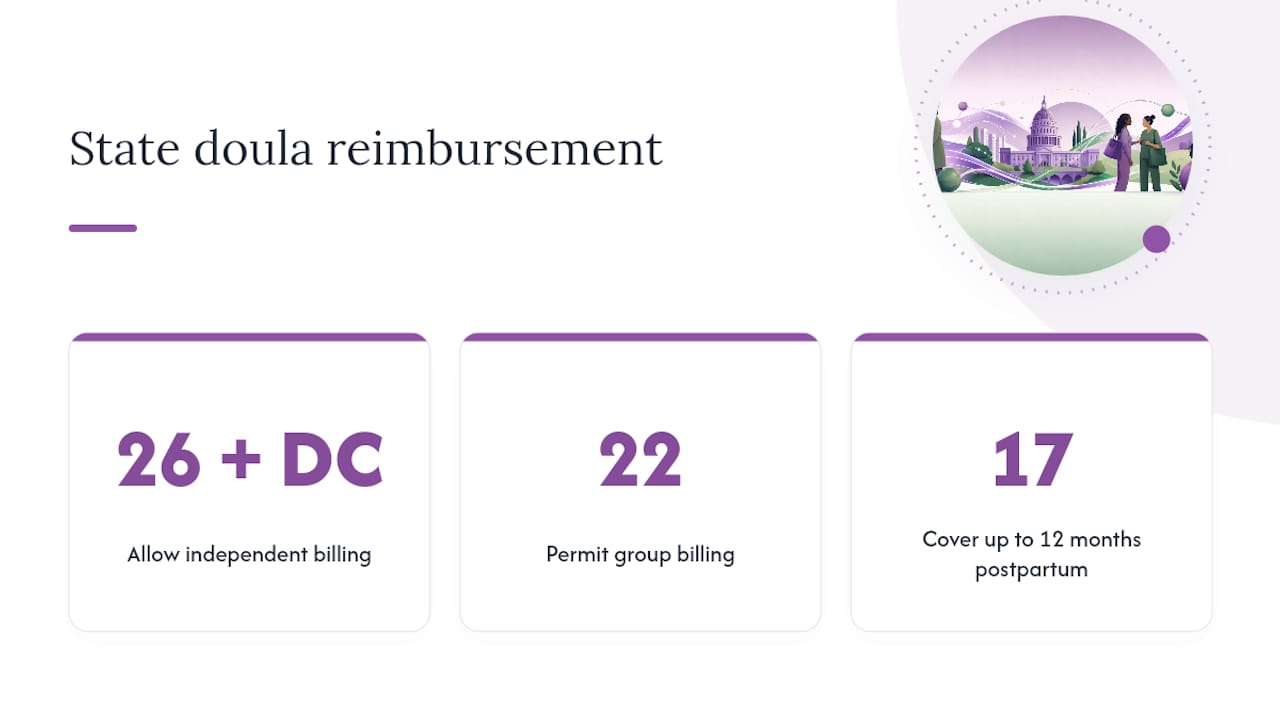
The NASHP snapshot also breaks down practical enrollment mechanics: 26 states plus DC now let doulas practice and bill independently, 22 permit group billing, and 17 extend reimbursement through 12 months postpartum rather than cutting off at six weeks. That last detail matters for your revenue. If your state only covers the immediate postpartum window, your billable relationship with a client ends far sooner than your actual involvement in her care.
Before doing anything else, pull up your specific state’s policy on the NHeLP Doula Medicaid Project tracker. It’s the closest thing to a single source of truth this field has.
FFS or MCO: Who Actually Pays You?
Fee-for-service (FFS) and Medicaid Managed Care Organizations (MCOs) are not interchangeable, and confusing them is where a lot of first-time claims go sideways. Under FFS, you enroll directly with the state as a Medicaid provider using your Type 1 NPI, then submit claims straight to the state’s Medicaid agency. It’s the more predictable path, with published fee schedules and clearer timelines.
MCO billing is messier. Most states funnel a majority of their Medicaid population through managed care plans, which means you may need separate credentialing and contracting with each plan operating in your area, on top of your state enrollment. Skipping FFS enrollment first is a common mistake. Many states won’t let you contract with an MCO until your FFS enrollment is active, so trying to shortcut straight to plan credentialing often stalls the whole process.
FFS: one enrollment, one biller, more predictable timelines.
MCO: multiple plan contracts, separate credentialing, potentially faster growth once you’re in.
Pro Tip: Ask your state Medicaid agency whether it allows group billing under a Type 2 NPI. Several states permit a doula collective to bill under one organizational number, which cuts down the paperwork every individual doula would otherwise repeat.
What Do You Need to Enroll and Get Credentialed?
Enrollment requirements vary by state, but a consistent pattern shows up in nearly every doula Medicaid program. Work through these roughly in order:
Get a Type 1 NPI. This is free and takes about ten minutes online through the National Plan and Provider Enumeration System, but nothing else can start without it.
Confirm your certification pathway. States either require a specific approved certifying body or accept a legacy pathway based on documented experience if you were practicing before the program launched.
Carry liability insurance. Most state manuals list minimum coverage amounts as a condition of enrollment.
Register on your state’s doula registry, if one exists. Some states, like Maryland, route this through a dedicated portal.
Complete provider enrollment. In Maryland, that means ePREP, the state’s electronic Provider Revalidation and Enrollment Portal. New York simplifies this further with a statewide standing order, removing the need for an individual physician referral before you can bill.
Budget for real costs here: certification programs often run several hundred dollars, liability insurance adds an annual premium, and portal processing can take weeks rather than days. Nothing about this is instant.
Pro Tip: Start your NPI application and certification renewal at the same time. They don’t depend on each other, and running them in parallel can save you two or three weeks off your total enrollment timeline.
Codes, Units, and Sample State Rates
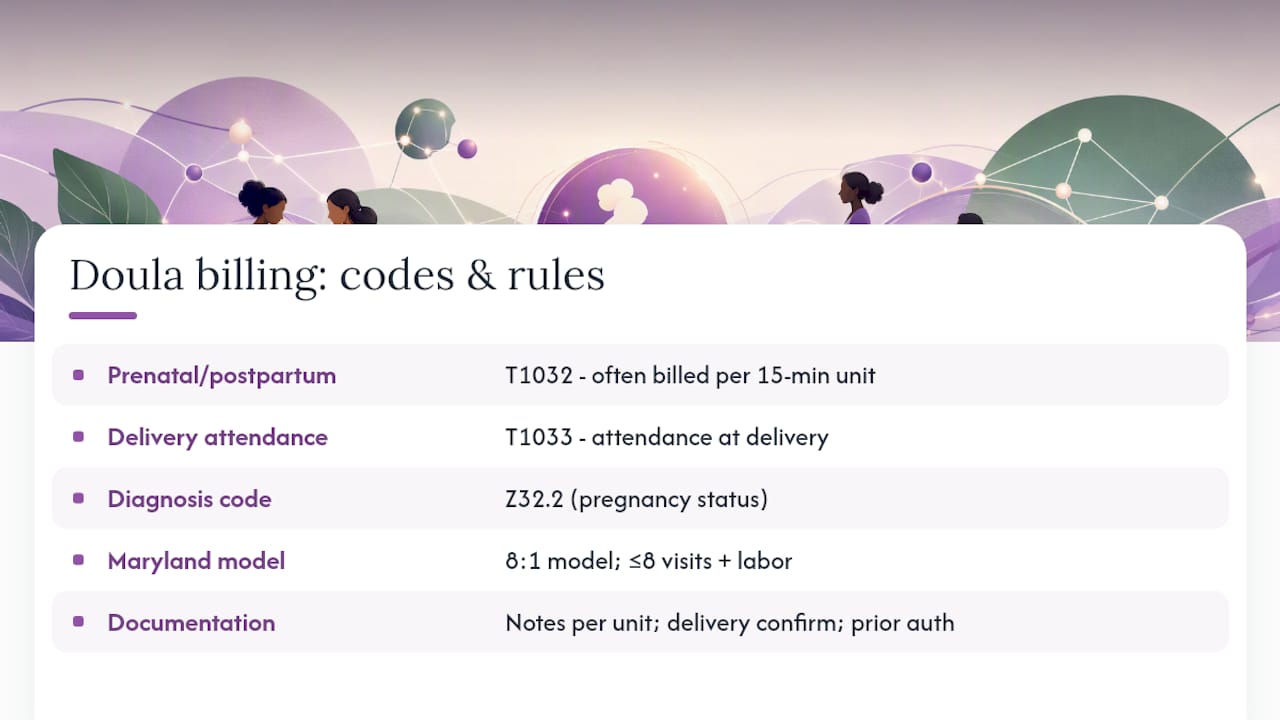
Doula Medicaid billing runs on a small set of codes, but the details matter more than the codes themselves. Two HCPCS codes show up across nearly every state manual: T1032 for prenatal and postpartum visits, and T1033 for attendance at delivery. States commonly pair these with a diagnosis code like Z32.2 to indicate pregnancy status, and many states bill T1032 in 15-minute units rather than as a flat per-visit charge.
Maryland’s Medicaid Doula Services Program Manual is the clearest public example of how this works in practice. It authorizes an 8:1 model, up to eight perinatal visits plus labor attendance, with T1032 billed per 15-minute unit and a flat labor and delivery rate established as of 2023. That’s the level of specificity you want to find in your own state’s manual before you submit a single claim.
Rates and structures vary widely elsewhere:
Georgetown’s Center for Children and Families tracks these reimbursement ranges and documents just how much variation exists between states, along with the upward trend in states adopting coverage since 2022. NHeLP has flagged a real concern behind those numbers: low reimbursement in early-adopter states measurably reduced doula participation, because rates often didn’t account for the hours doulas spend on documentation, coordination, and travel that never show up as a billable visit.
Whatever your state’s code set, keep documentation tight: visit notes for each unit billed, confirmation of attendance at delivery, and any prior authorization your state requires before the claim goes out.
Why Do Doula Medicaid Claims Get Denied?
Denials cluster around a handful of predictable causes, and almost all of them are preventable with a pre-submission check.
Wrong code or missing modifier. T1032 versus T1033 confusion, or a missing modifier the state requires for unit billing.
Provider not fully enrolled. Submitting a claim before your NPI or state enrollment is active guarantees a rejection.
Wrong place-of-service code. Telehealth visits often carry restrictions doulas don’t expect, especially for postpartum check-ins.
Missing documentation. No visit notes, no time breakdown, no signed attestation of attendance at delivery.
MCO credentialing gaps. You’re enrolled in FFS but never completed the separate plan contracting an MCO requires.
Pro Tip: Build a one-page pre-claim checklist: correct code, correct modifier, active enrollment status, matching place-of-service, and attached documentation. Running every claim through it before submission catches most denials before they happen.
Your 30 to 90 Day Roadmap to Your First Payment
Getting from “Medicaid covers doulas in my state” to an actual deposit takes real time. Here’s a realistic sequence:
Days 1 to 30: Confirm your state’s coverage on the NASHP or NHeLP tracker, apply for your Type 1 NPI, gather certification documents and liability insurance, and start your state enrollment application.
Days 30 to 60: Finish FFS enrollment, confirm your registry status if your state requires one, and begin any MCO credentialing your state’s plans demand.
Days 60 to 90: Submit a test claim, set up a system to track 15-minute units accurately, and build your denial-prevention checklist before real volume hits.
Expect your first payment cycle to run longer than you’d like. Portal processing delays are common, and few states pay same-month. Budget accordingly, and consider whether joining a doula group for shared billing, or bringing in outside billing support, makes more sense than handling every claim solo.
How a Billing Partner Speeds Up Doula Medicaid Payments
Provider enrollment, code mapping, modifier review, and denial appeals add up to a part-time job most doulas didn’t sign up for. A specialized billing partner handles that operational layer: enrollment paperwork, CPT/HCPCS mapping specific to your state’s rules, ongoing claims follow-up, and appeals when something gets denied anyway.
Doulas who outsource enrollment and claims tracking spend that time with clients instead of fighting portal logins and code lookups. That’s the actual trade being made.
Best Way Medical Billing works specifically with midwives, doulas, and other women’s health providers, which means the coding review and appeals process is built around maternity billing rules rather than adapted from generic medical billing. If your claim volume is still small, doing it yourself might make sense for now. Once you’re juggling multiple states, MCO contracts, or more than a handful of clients, the math usually tips toward outsourcing.
A Practical Note From Best Way Medical Billing
Doula Medicaid reimbursement is workable, but the details punish shortcuts. We help doulas enroll faster and get paid without the guesswork. Talk with our practice consultation team to get started.
Frequently Asked Questions
Does Medicaid reimburse doulas in every state? No. As of March 2026, 26 states and Washington, DC reimburse doula services through Medicaid. Coverage, rates, and enrollment rules differ by state, so check your own state’s tracker before assuming coverage applies to you.
What codes do doulas use to bill Medicaid? Most states use T1032 for prenatal and postpartum visits and T1033 for attendance at delivery, often paired with diagnosis code Z32.2. States like Maryland bill T1032 in 15-minute units rather than flat per-visit rates.
Do doulas need an NPI to bill Medicaid? Yes. A Type 1 National Provider Identifier is required before you can enroll as a Medicaid provider in any state, regardless of whether you’ll bill through fee-for-service or a managed care plan.
How long does it take to start getting paid? Realistically, 30 to 90 days from starting your enrollment application to submitting your first successful claim, factoring in NPI processing, certification verification, and state portal review times.
Should I bill Medicaid myself or use a billing service? If you have one or two clients and one state’s rules to learn, doing it yourself is manageable. Once you’re managing multiple states, MCO contracts, or growing client volume, a billing partner like Best Way Medical Billing can cut denial rates and speed up payment cycles.
This article is general information, not a substitute for advice from a qualified financial advisor. Consult a qualified financial professional about your own circumstances before acting on anything here.
Sources
Recommended


Comments