
OB Global Billing in 2027: What U.S. Practices Must Do Now


Starting January 1, 2027, the single global obstetric bundle is gone. The CPT® 2027 maternity care code changes replace legacy codes like 59400, 59510, 59610, and 59618 with a service-level structure that bills antepartum, labor management, delivery, and postpartum as separate, discrete encounters. Every OB practice, birth center, and midwifery group in the United States needs to act before that date or face a wave of denials and underpayments that will be difficult to unwind.
Three things your practice should do this week:
Update your billing rules and encounter types. Pull your current global maternity codes from your fee schedule and flag them for replacement. Your clearinghouse and billing team need to know which codes are retiring.
Enable episode and prenatal tracking in your EHR. The new structure requires linking every encounter to a pregnancy episode. If your EHR cannot do that today, the configuration work starts now.
Run a payer-coverage audit for your top five payers. Contract language written around the global bundle may not automatically translate to service-level reimbursement. Gaps in that language are where revenue disappears.
Practices that delay this transition risk not just claim denials but systematic underpayment across an entire delivery season.
Key Takeaways
The single most important action any U.S. OB practice can take right now is to configure episode tracking in the EHR and update the charge master before the September 2026 deadline, because billing errors during the transition can cost independent practices a substantial amount of revenue annually.
Point | Details |
CPT 2027 effective date | January 1, 2027 replaces global bundle codes with four service-level phases: antepartum, labor management, delivery, postpartum. |
Documentation is the linchpin | Every claim line needs date, encounter type, clinical findings, and episode linkage to survive audit or denial appeal. |
Payer contracts need review now | Budget-neutral RVU design does not guarantee your contract pays correctly; verify each payer’s fee schedule and bundling language before January 2027. |
Error rate revenue risk | A 5–10% error rate in OB billing can cost independent practices hundreds of thousands of dollars annually; weekly delivery audits reduce that risk. |
Bestwaymedicalbilling transition support | Bestwaymedicalbilling offers coding updates, EHR episode setup, denial appeals, and a practice consultation to build a payer-specific transition plan. |
Table of Contents
What the CPT 2027 maternity-code overhaul does and why it matters
Practical mapping: legacy global CPT codes to new service-level phases
When a practice can still bill a global package and when to bill individual services
Documentation standards, E/M interplay, and modifier guidance for the new framework
State Medicaid example: what Medi-Cal shows you to check at the state level
A women’s health billing specialist’s perspective on implementation pitfalls
Bestwaymedicalbilling supports practices through the OB billing transition
What the CPT 2027 maternity-code overhaul does and why it matters
The structural change is significant. For decades, ob global billing worked on a nine-month bundled model: one code, one payment, covering everything from the first prenatal visit through six weeks postpartum. The CPT® 2027 revision dismantles that bundle entirely and replaces it with phase-specific codes that report antepartum care, labor management, the delivery itself, and postpartum care as separate billable services.
“The global maternity package has long obscured care variation, made team-based billing nearly impossible to capture accurately, and prevented meaningful measurement of individual service components. Service-level reporting corrects all three problems at once.” — AMA/ACOG rationale, as summarized in ACOG payment guidance
The effective date is January 1, 2027. ACOG recommends that practices begin reporting antepartum visits using E/M codes during 2026 as a transitional step, so the operational muscle is already in place before the new codes go live.
Here is the milestone timeline practices should follow:
Milestone | Target Date | Action |
Begin E/M antepartum reporting | Now through December 2026 | Switch antepartum visits to E/M codes per ACOG guidance |
EHR and billing system updates | By September 2026 | Configure episode tracking, new encounter types, updated fee schedule |
Payer contract review complete | By October 2026 | Confirm reimbursement language for each phase code with top payers |
New code structure live | January 1, 2027 | All maternity claims submit under service-level codes |
The rationale from AMA and ACOG centers on three goals: transparency in how care is delivered and paid for, alignment with team-based care models where multiple clinicians share a pregnancy, and the ability to measure and improve maternal outcomes. The CDC’s work on preventing pregnancy-related deaths underscores exactly why granular billing data matters: you cannot track what you cannot measure, and a single bundled code tells you almost nothing about where care gaps occur.
For practices, the expected benefits include cleaner attribution of services in multi-provider settings, fewer disputes over split-care billing, and a reimbursement structure that actually reflects the work performed at each phase. For payers and quality programs, service-level data creates a foundation for outcome measurement that the global bundle never could.
Practical mapping: legacy global CPT codes to new service-level phases
The table below gives your billing team a working reference. Legacy global codes on the left; the new phase-level reporting structure on the right. This is not a one-to-one swap. Each legacy code explodes into multiple phase-specific claim lines.
Individual maternity codes that were already in use as standalone lines remain relevant and become more central under the new structure. The obstetrics coding reference guide catalogs these in detail:
Antepartum-only: 59425 (4–6 antepartum visits), 59426 (7 or more antepartum visits)
Delivery-only (vaginal): 59409 (vaginal delivery only), 59410 (vaginal delivery with postpartum)
Delivery-only (cesarean): 59514 (cesarean delivery only), 59515 (cesarean with postpartum)
Postpartum-only: 59430
These codes were previously used mainly for split-care or transfer scenarios. After January 1, 2027, they become the building blocks of standard billing for most practices.
Pro Tip: When configuring your EHR, create a pregnancy episode record at the first confirmed prenatal visit and tag every subsequent encounter to that episode ID. Map each encounter type (antepartum, labor, delivery, postpartum) to its corresponding new CPT code in your charge master. This prevents the most common error: a coder selecting a legacy global code out of habit because the encounter type was never updated.
When a practice can still bill a global package and when to bill individual services
The global package is not dead for every scenario. It survives where one practice handles the entire continuum of care. The decision logic is straightforward.
Bill a global package when all of the following are true:
The same practice (same tax ID) provides all antepartum, delivery, and postpartum care.
The patient completes a sufficient number of antepartum visits (historically around 13, though payer contracts vary).
Delivery is performed by a clinician within that same practice.
No payer episode crosses a plan-year boundary that would split the claim.
Bill individual service codes when any of the following apply:
Transfer of care. If a patient transfers from one practice to another mid-pregnancy, the first practice bills antepartum-only codes for the visits it provided. The receiving practice bills from the point of transfer forward.
Multiple payers. A patient who changes insurance mid-pregnancy creates two separate billing episodes. Each payer covers only the services rendered during its coverage period.
Pregnancy ending early. An early pregnancy loss, ectopic pregnancy, or elective termination before the delivery phase means no global package applies. Bill the antepartum visits and any procedure codes separately.
Delivery by an unrelated hospitalist or covering group. If a hospitalist or on-call group not affiliated with the prenatal practice performs the delivery, that group bills delivery-only codes. The prenatal practice bills antepartum-only.
Late entry to care. A patient who presents for the first time in the third trimester with fewer antepartum visits than the payer’s minimum threshold does not qualify for the global package. Bill the visits and delivery separately.
The global maternity package payment policy from state-level payer documents lists these exclusions explicitly and is worth pulling for your own payer contracts as a comparison template.
A quick multi-provider example: Patient A receives 10 antepartum visits at a midwifery group, then transfers to a hospital OB practice at 36 weeks for a high-risk delivery. The midwifery group bills 59426 (7 or more antepartum visits). The hospital OB practice bills a delivery-only code. Neither bills a global package because neither provided the full continuum.
Documentation standards, E/M interplay, and modifier guidance for the new framework
Documentation is where most practices will either win or lose the 2027 transition. A claim line without the right chart support is a denial waiting to happen.

Minimum documentation fields by phase:
Phase | Required Documentation Fields | Why It Matters for Audit Defense |
Antepartum | Date, gestational age, vital signs, clinical findings, risk assessment, plan | Supports visit count and E/M level selection |
Labor management | Date/time of admission, labor progress notes, interventions, fetal monitoring findings | Distinguishes labor management from delivery |
Delivery | Delivery date/time, delivery type, infant details (weight, APGAR), complications, provider name | Required for delivery-code specificity |
Postpartum | Date of visit, weeks postpartum, clinical findings, contraception/lactation counseling | Supports standalone postpartum code if billed separately |
E/M vs. maternity-service codes during antepartum care
This is the area where the most confusion will occur. Under the current global bundle, antepartum visits are folded into the package and not billed separately. Under the 2027 structure, and during the 2026 transition period, ACOG recommends using E/M codes for antepartum visits. That means selecting the appropriate office/outpatient E/M level (99202–99215) based on medical decision-making or total time, rather than using a maternity-specific visit code.
ACOG also recommends appending the HCPCS modifier TH to antepartum E/M claims to flag them as obstetric-related. This helps payers distinguish a routine prenatal visit from an unrelated office visit and reduces the risk of a bundling denial.
A few additional modifier situations to know:
Modifier 22 (increased procedural services): appropriate when a delivery involves significantly greater work than typical, such as a complex cesarean with extensive adhesions. Document the additional time and complexity explicitly.
Modifier 52 (reduced services): use when a procedure is partially performed, such as a postpartum visit that is significantly abbreviated due to patient circumstances.
Place of service codes matter more under service-level reporting. A labor management encounter in a hospital setting carries a different POS than an antepartum visit in an office. Confirm your billing system maps these correctly.
The initial problem-oriented visit that confirms a pregnancy is a common misclassification point. That visit should be billed with a standard E/M code and should not be folded into the global package or antepartum visit count. Getting this wrong causes both underbilling and downstream denial risk.
Pro Tip: Build a documentation checklist into your EHR as a required field set for each encounter type. A coder who cannot close an antepartum note without entering gestational age, risk level, and visit classification is a coder who cannot accidentally submit a claim without the data to defend it.
How CMS, state Medicaid, and commercial payers are likely to handle reimbursement and patient cost-sharing
The short answer on CMS: the RUC analysis supporting the new maternity codes was designed to be budget neutral, meaning the total RVUs across the new service-level codes should approximate what the legacy global codes paid in aggregate. MedPAC and RUC analyses indicate this neutrality expectation, but “budget neutral in aggregate” does not mean “neutral for your specific practice.” A practice that historically billed more antepartum visits than average may see a net gain. One that billed fewer may not.
What to do before payer contracts are renegotiated:
Pull your top five payers’ current fee schedules and identify every maternity-related code and its allowed amount.
Request written confirmation from each payer that the new service-level codes will be covered and at what rate.
Submit test claims in late 2026 if your payer allows it, or at minimum submit a letter of inquiry about their implementation timeline.
Review bundled-service language in each contract. Some contracts explicitly bundle antepartum visits into the delivery payment. That language needs to be amended before January 1, 2027.
Amend your own fee schedule to include the new phase-level codes with realistic charge amounts.
State Medicaid variability is real. Medi-Cal in California, for example, maintains its own global maternity package definitions and reimbursement rates that do not automatically mirror CMS fee schedule changes. A state Medicaid program may adopt the new CPT codes on January 1, 2027, or it may maintain its own billing rules for months or years afterward. Never assume your state Medicaid program follows the CMS timeline.
Patient cost-sharing is an underappreciated risk. When care is bundled, a patient typically pays one copay or one deductible application. When care is unbundled into four separate claim lines, each line may trigger a separate cost-sharing event depending on how the plan’s benefit design is written. Reporting on the patient-facing impacts of unbundling notes that clearer cost breakdowns are a benefit, but increased patient out-of-pocket exposure is a real risk unless payers adjust their benefit designs. Practices should prepare patient-facing notices that explain the change and set expectations before the first 2027 delivery.
Revenue-cycle risks and a step-by-step readiness checklist
The revenue risk from a poorly managed transition is not theoretical. Revenue-cycle playbook data shows that a 5–10% error rate in OB billing can cost independent practices hundreds of thousands of dollars annually. A major code transition, with staff still learning new patterns and EHR systems not yet configured, is exactly when error rates spike.
The risks cluster into three categories:
Denials from submitting legacy global codes after January 1, 2027, or from submitting new codes without the documentation to support them.
Underpayments from payers that process new codes against old fee schedules or apply bundling edits that were written for the global package.
Patient balance surprises from cost-sharing structures that were not updated to reflect the new claim-line structure.
Phased readiness checklist:
Technical (by September 2026)
Update charge master with all new maternity CPT codes; retire legacy global codes or flag them as inactive.
Configure EHR episode tracking so every encounter links to a pregnancy episode ID.
Update claim-edit rules in your clearinghouse to reflect new code combinations.
Test claim submission with at least one payer before the go-live date.
Process (by October 2026)
Build a maternity billing flowchart into your EHR workflow. Episode tracking and a billing flowchart are among the highest-return process investments for this transition.
Define visit-classification logic: which encounter types map to antepartum, labor management, delivery, and postpartum.
Establish a transfer-of-care protocol that triggers automatic code-selection review.
People (by November 2026)
Train all coders and billers on the new code structure, modifier rules, and E/M antepartum reporting.
Train front-desk and clinical staff on episode labeling at intake.
Designate a maternity billing governance lead who owns the transition and resolves coding disputes.
Measurement (ongoing from January 2027)
Run a weekly audit on all deliveries from the prior week: confirm all four phase codes were submitted, documentation is complete, and no legacy codes were used.
Track denial rate by code and phase. A spike in antepartum denials signals a documentation or modifier problem. A spike in delivery denials often points to a payer contract issue.
Set a monthly KPI review: clean claim rate, days in AR for maternity claims, and denial rate by phase.
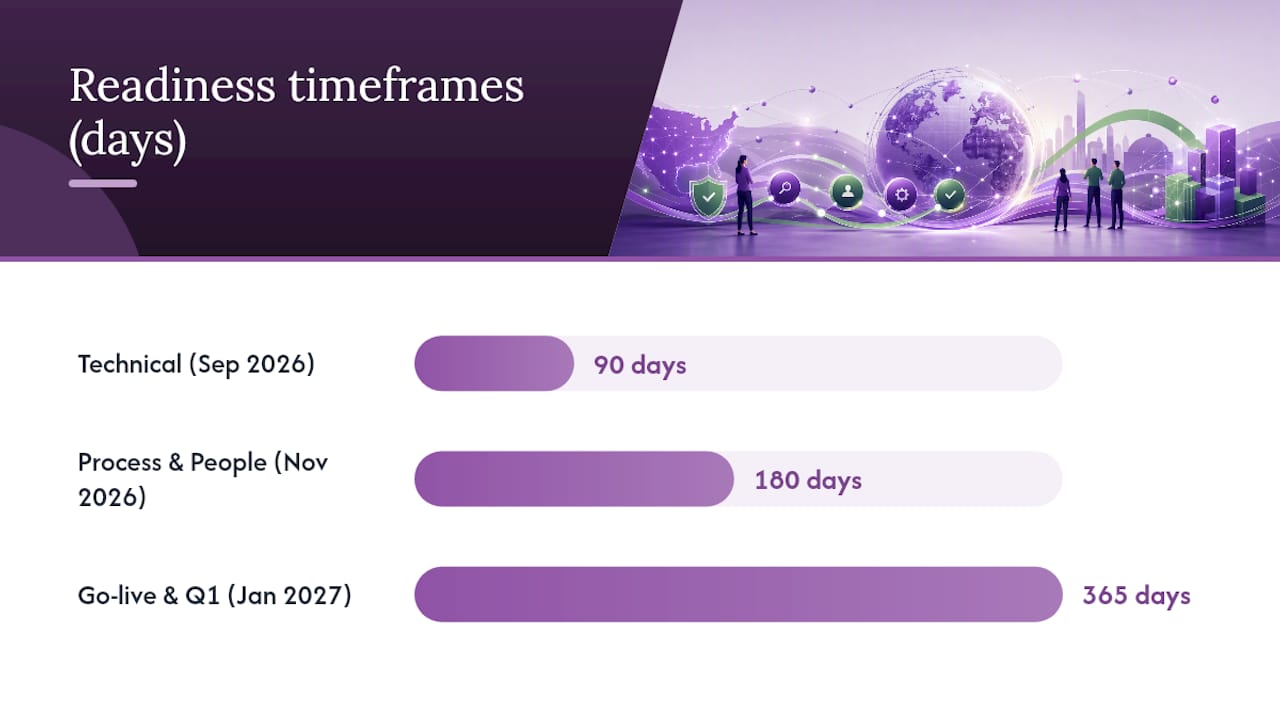
90/180/365-day implementation timeline:
Timeframe | Milestone | Owner |
90 days (by Sept 2026) | EHR configured, charge master updated, test claims submitted | Billing manager + IT |
180 days (by Nov 2026) | All staff trained, payer contracts reviewed, patient notice drafted | Practice manager + billing lead |
365 days (Jan 2027 + Q1 review) | New codes live, weekly audits running, first-quarter denial analysis complete | Billing governance lead |
Pro Tip: For practices with rotating hospitalists or covering physicians, build a standing order into your billing workflow: any delivery performed by a clinician outside your practice’s tax ID triggers an automatic delivery-only code review. Do not let a hospitalist delivery slip through as a global package claim — that is one of the fastest paths to a payer audit.
Concrete claim examples for common OB billing scenarios
The scenarios below show how to construct claim lines under both the current and transitional frameworks. Use these as templates for staff training and EHR configuration testing.
Scenario 1: Antepartum-only (transfer of care out)
Clinical summary: Patient receives 8 antepartum visits at a midwifery group, then transfers to a hospital OB practice at 34 weeks due to preeclampsia. The midwifery group does not perform the delivery.
Field | Value |
CPT | 59426 (7 or more antepartum visits) |
Place of service | Office visit |
Diagnosis pointer | O14 (Mild to moderate preeclampsia) |
Modifier | None required; document transfer date and reason in chart |
Documentation note | Record visit count, transfer date, receiving provider name, and clinical reason for transfer |
Scenario 2: Vaginal delivery (full global package, current framework)
Clinical summary: Same practice provides all prenatal care (13 visits), vaginal delivery, and postpartum visit. Patient has commercial insurance. Claim submitted before January 1, 2027.
Scenario 3: Cesarean delivery (service-level, post-January 2027)
Clinical summary: Same practice provides all care. Cesarean performed for failure to progress. Claim submitted after January 1, 2027 under new service-level structure.
Field | Value |
CPT Line 1 | New antepartum phase code (per AMA 2027 release) |
CPT Line 2 | New labor management phase code |
CPT Line 3 | New cesarean delivery phase code |
CPT Line 4 | New postpartum phase code (or 59430 if billed separately) |
Place of service | Office visit for antepartum/postpartum; 21 (Inpatient) for labor/delivery |
Diagnosis pointer | O66 (Failed trial of labor) |
Modifier | TH on antepartum E/M lines; Modifier 22 if cesarean complexity warrants it |
Documentation note | Labor progress notes, operative report, delivery summary, postpartum visit note |
Scenario 4: Early pregnancy loss
Clinical summary: Patient presents at 9 weeks with missed abortion. No antepartum visits had been billed under a global package. Uterine evacuation performed in office.
Scenario 5: Late entry to care, vaginal delivery
Clinical summary: Patient presents at 32 weeks with no prior prenatal care. Practice provides 4 antepartum visits, then performs vaginal delivery and postpartum care.
State Medicaid example: what Medi-Cal shows you to check at the state level
Medi-Cal is a useful illustration because California’s Medicaid program has historically maintained its own global maternity package definitions, reimbursement rates, and documentation requirements that diverge from CMS fee schedule rules. What applies in California may not apply in Texas, Florida, or New York. The state-level payer policy framework makes clear that state programs differ widely in postpartum period definitions, visit-count thresholds, and clinical-validation practices.
Five checks every practice billing Medicaid must run:
Effective dates. Confirm when your state Medicaid program will adopt the 2027 CPT codes. Some states lag CMS by six months or more. Submitting new codes before your state program recognizes them guarantees a denial.
Minimum visit counts. States define their own thresholds for what qualifies as a complete global package. Medi-Cal’s manual specifies its own visit requirements. Pull your state’s current manual and note the number.
Postpartum period definition. Federal guidance defines postpartum as six weeks. Some state programs use a different window for billing purposes. A mismatch between your billing and the state’s definition is a common audit trigger.
Modifier rules. State Medicaid programs may require modifiers that commercial payers do not, or may reject modifiers that commercial payers expect. Confirm modifier requirements with your state’s provider manual before January 2027.
Clinical validation and prepay review. Several state Medicaid programs conduct prepay clinical validation on maternity claims, particularly for cesarean deliveries. Know whether your state does this and what documentation it requires.
Concrete next steps for high-Medicaid practices:
Download your state Medicaid provider manual’s maternity billing section and save it as a dated PDF. Manuals update without notice.
Contact your state Medicaid managed care organization’s provider relations line and ask specifically about their CPT 2027 implementation timeline.
If your state uses a managed care organization for Medicaid, that MCO may have its own policy layered on top of the state plan. Request the MCO’s maternity billing policy in writing.
A women’s health billing specialist’s perspective on implementation pitfalls
The part of this transition that keeps me up at night is not the code change itself. Coders can learn new codes. What is harder to fix is the human variability that surfaces during any major billing overhaul: the front-desk staff who forgets to assign an episode label at intake, the covering physician who documents a delivery without noting the labor management phase, the biller who defaults to a legacy code because the EHR dropdown still shows it.
Governance is the answer, and most practices underinvest in it. Assign one person to own the maternity billing transition. Not a committee. One person with the authority to enforce documentation standards, resolve coding disputes, and escalate payer issues. That person should be reviewing every delivery claim in the first quarter of 2027 before it goes out the door.
The single most practical thing I have seen work is to require coders to select an episode label at the point of charge entry, not as an afterthought. When episode assignment is a required field, not an optional one, the downstream coding decisions almost always fall into place. It forces the question “which phase of care is this?” at the moment it is easiest to answer.
Bestwaymedicalbilling supports practices through the OB billing transition
The CPT 2027 change is not a one-time update. It is a structural shift that touches your EHR configuration, your fee schedule, your payer contracts, your staff training, and your audit cadence simultaneously. Practices that try to manage all of that internally while also seeing patients will miss something.

Bestwaymedicalbilling works specifically with midwives, birth centers, doulas, and women’s health practices. The team handles coding updates and denial appeals specific to maternity claims, EHR episode setup and encounter-type configuration, and the full claims management cycle from charge entry through payment posting. For practices preparing for the 2027 transition, the starting point is a practice consultation where you bring your current fee schedule, your top-five payer contracts, and your EHR encounter-type list. From there, the team identifies the gaps and builds a transition plan specific to your volume and payer mix. Book your transition consult now before the September 2026 configuration deadline.
Sources
This article is general information, not a substitute for advice from a qualified financial advisor. Consult a qualified financial professional about your own circumstances before acting on anything here.
Recommended


Comments